
Do you need a value model?
(and why its different to a pricing model)

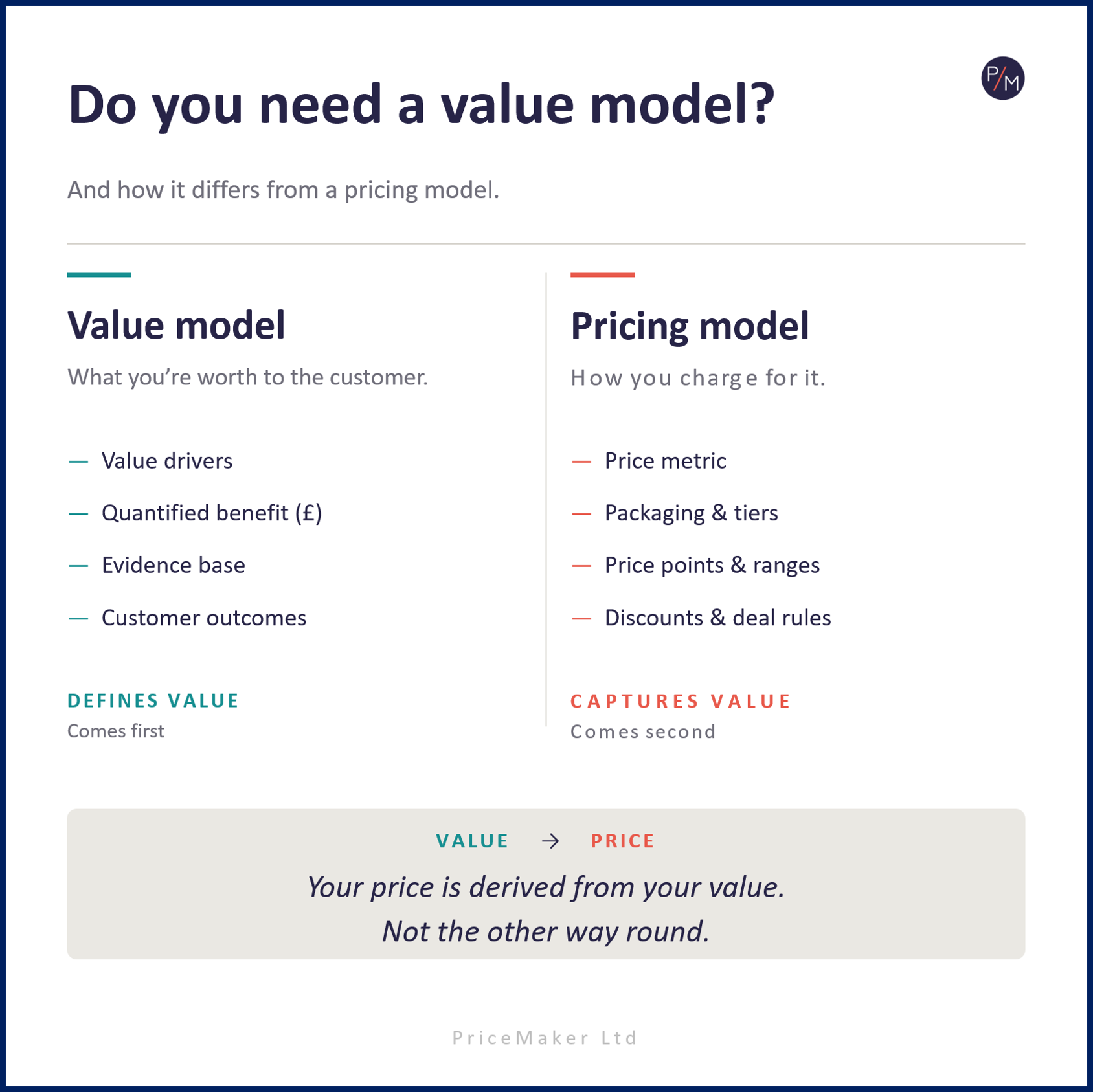
When a company tells me it has a pricing problem, the problem is usually somewhere else.
Prices get set, then second-guessed, discounts creep in, and a deal that looked certain slows down or dies the moment it reaches the customer’s finance team.
The instinct is to go back to the price and tweak it again.
But the price was never the issue.
The issue is that nobody in the business can say, clearly and with evidence, what their product is actually worth to the customer.
Price is the last decision you make, not the first, and you can’t make it well until you’ve done the work underneath it.
That work has a name. It’s called a value model. And the question I’d put to most leadership teams I meet is a simple one: do you have one?
What a value model actually is.
Let me be plain about what I mean, because the term sounds more abstract than the thing.
A value model is a structured, evidence-based picture of the value your product or service delivers to a customer.
It sets out the few places where you make a measurable difference to their business: the costs you take out, the time you save, the revenue you help them win, the risk you remove.
It puts a number against each one. And it shows the workings, whether those numbers come from customer data, sector benchmarks or your own results.
It isn’t a price list, and it isn’t an ROI calculator or a slide with a big percentage on it. Those are things you build once you have a value model. The model is the thinking underneath them.
How to tell if you’re missing one.
Most businesses I work with don’t have one. Here’s how you can tell whether you’re one of them:
You discount to close, almost by reflex.
Your deals slow down or stall when they reach the customer’s finance team.
Your prices were set by adding a margin to cost, by copying a competitor, or by a number that felt about right a few years ago.
Your salespeople can’t give the same answer twice when a buyer asks what the return will be.
The clearest version of your value lives in the founder’s head, and nowhere else.
You’re about to launch something new and you honestly don’t know what to charge for it.
Each of those is the same problem wearing different clothes. The value is real. It has just never been worked out, written down or defined.
You might not need one.
If you sell something simple and transactional, where the price is obvious and nobody argues with it, a value model might be overkill.
If you’re very early, still working out whether anyone wants your product at all, it’s probably too soon.
But once price becomes a negotiation, once finance gets involved, once you start handing the sales conversation to people who aren’t you (the founder), the absence of a value model begins to cost you.
The tool is not the model
There’s a lot of good software in this space now, and it’s improving fast. Tools that help a sales team build a business case, quantify value in a live conversation, produce a credible ROI on the spot, and many of them are very good.
But a tool can only present a value model. It can’t invent one.
Give the best software in the category a value proposition you’ve never actually quantified, and it hands you back a beautifully produced guess.
The tool is the engine. The value model is the fuel. Plenty of companies have bought the engine and never thought about the fuel.
Why this matters more now.
Two things have changed.
First - when anyone can generate a slick ROI deck in seconds, a slick ROI is worth very little. The only thing that carries weight is whether the claim is true and whether it survives scrutiny. That comes from the model, not the output.
Second - buyers are beginning to point AI at their own decisions. More and more, the thing reading and comparing your value claim won’t be a person. It’ll be a model working on the buyer’s behalf. That puts a premium on value claims that are structured and machine-readable, rather than buried in a PDF. The companies that get this right will be legible to the buyer’s AI. The rest will be ignored.
The early adopter advantage
One more reason to pay attention. In the US, this is established practice. Large software firms employ whole teams of “value engineers” whose entire job is the work I’ve described above.
In the UK, and across much of Europe, especially in the mid-market, it’s barely discussed. That gap is the opportunity. Do this now and you aren’t catching up with your peers. You’re ahead of them.
What you actually get
None of this is magic, and I won’t pretend a value model adds forty per cent to your revenue on its own.
What it does is more foundational. It gives your salespeople a credible answer when the buyer asks “why this price?”.
It takes the reflex out of discounting. It gives you a defensible basis for pricing something new. And it means your value story survives the founder leaving the room.
Everything else in pricing sits on top of it. You can’t communicate value you haven’t defined, and you can’t charge for value you can’t show.
So, do you need one?
If your pricing is calm, your deals close on value, and the case for what you’re worth is written down somewhere other than your own head, then maybe not.
If not, the honest question isn’t really whether you need a value model. It’s how long you can afford to keep sending out proposals without one.
Kind regards
Mark Peacock

I would go beyond saying that most companies need a value model (I agree with the exceptions you note). Companies need to publish their value models in a format that makes it easy for AIs to interpret and apply. This is why I am supporting The Value Project. The Value Project provides an open source JSON schema for representing a value model (and a pricing model). There is a website and the two JSON schema are available on GitHub. https://thevalueproject.org/