
How to identify competitor prices in B2B quote-led markets (using AI).

In quote-led markets (tech services, consulting, managed services, industrial equipment), nobody publishes a rate card.
Pricing is negotiated deal by deal, and your competitors want to keep it that way.
But what do you do when you really need to know how much your competitors are charging?
Most people will shrug their shoulders and think there is very little they can do.
You might be designing a new product offering or tendering for a large contract.
And not knowing your competitor’s prices is a critical gap in your decision-making.
You are often flying blind.
But with AI tools and advanced competitor research techniques, you can often find valuable information that can make or break a deal or a new product launch.
Where to start:
Use your AI to run an exhaustive search on your competitors’ websites, plus any other public information (press releases, new product announcements, financial information, analyst calls)
Create an AI agent to track key competitors systematically and update regularly (weekly or monthly) to provide a high level of summary of key information changes
Check FAQ pages as they are often surprisingly revealing and can include details on additional charges, usage limits, guarantees and renewal terms
Use tools like Visualping to track changes to competitor’s product & service pages
Set up an AI agent to track mentions of your key competitors on forums such as Redditt or Quora (and you can ask questions anonymously in those forums as well)
Check government websites such as G2 where vendors working on public contracts have to publish list prices for their services.
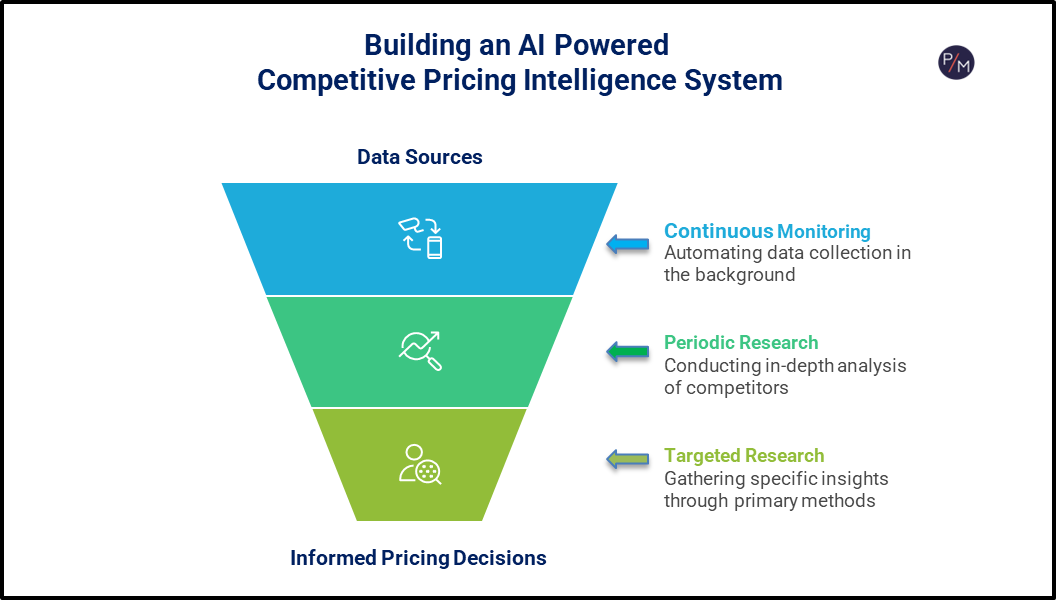
Building an AI-Powered Competitive Pricing Intelligence System
The strongest approach combines multiple sources and uses AI to synthesize them. Here is a simple 3 step approach you can start building.
1. Continuous Automated Monitoring (Always On)
Set up once and run these in the background: website monitoring tools, AI agent tracking workflows, conversation intelligence tools, social listening tools.
2. Periodic Deep Research
Run deep research queries on key competitors once a quarter (or even monthly) and cross reference the findings against your internal knowledge. (Be warned, LLMs often make mistakes with competitor prices!)
3. Targeted Primary Research
For higher stakes decisions, it is possible to conduct mystery shopping demos, interview former employees of your competitors (especially salespeople) and issue RFPs via third party agents, all of which will provide you with real insights into their actual pricing models and commercial terms.
Pulling it all together
The real value comes from synthesis. Use your AI to triangulate across sources and keep your sales team armed with current, reliable intelligence and make more informed decisions about your pricing model.
I’ve written a full guide covering each method in detail, including the specific tools, costs, the three-step implementation framework, and the common mistakes to avoid.
What’s your experience been with finding competitor pricing in B2B?
Let me know if you have found any other AI tools that are useful for this purpose.
Kind regards
Mark Peacock
